|
|
|
|
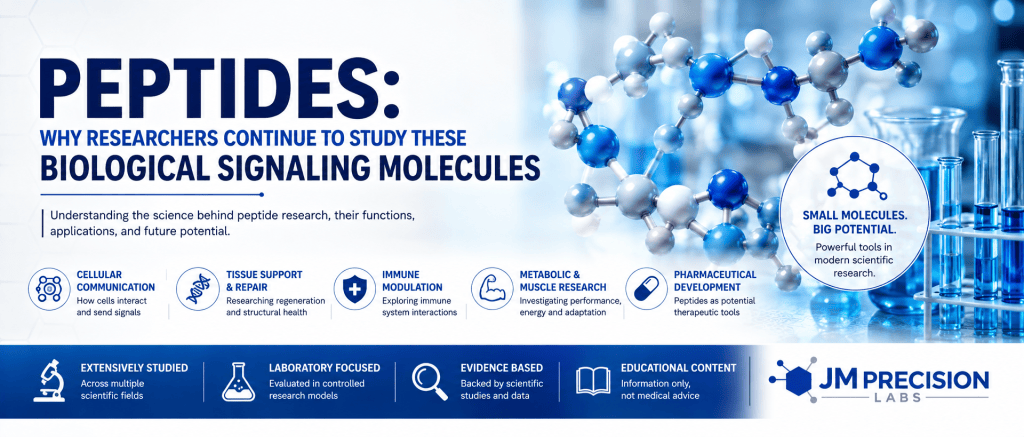
Peptides: Why Researchers Continue to Study These Biological Signaling Molecules
|
In biochemical research, peptides have become important tools for studying cellular communication, hormone signaling, tissue biology, immune activity, and pharmaceutical development. Their relatively small size and diverse biological roles allow researchers to examine highly specific pathways in controlled laboratory settings.
|
|
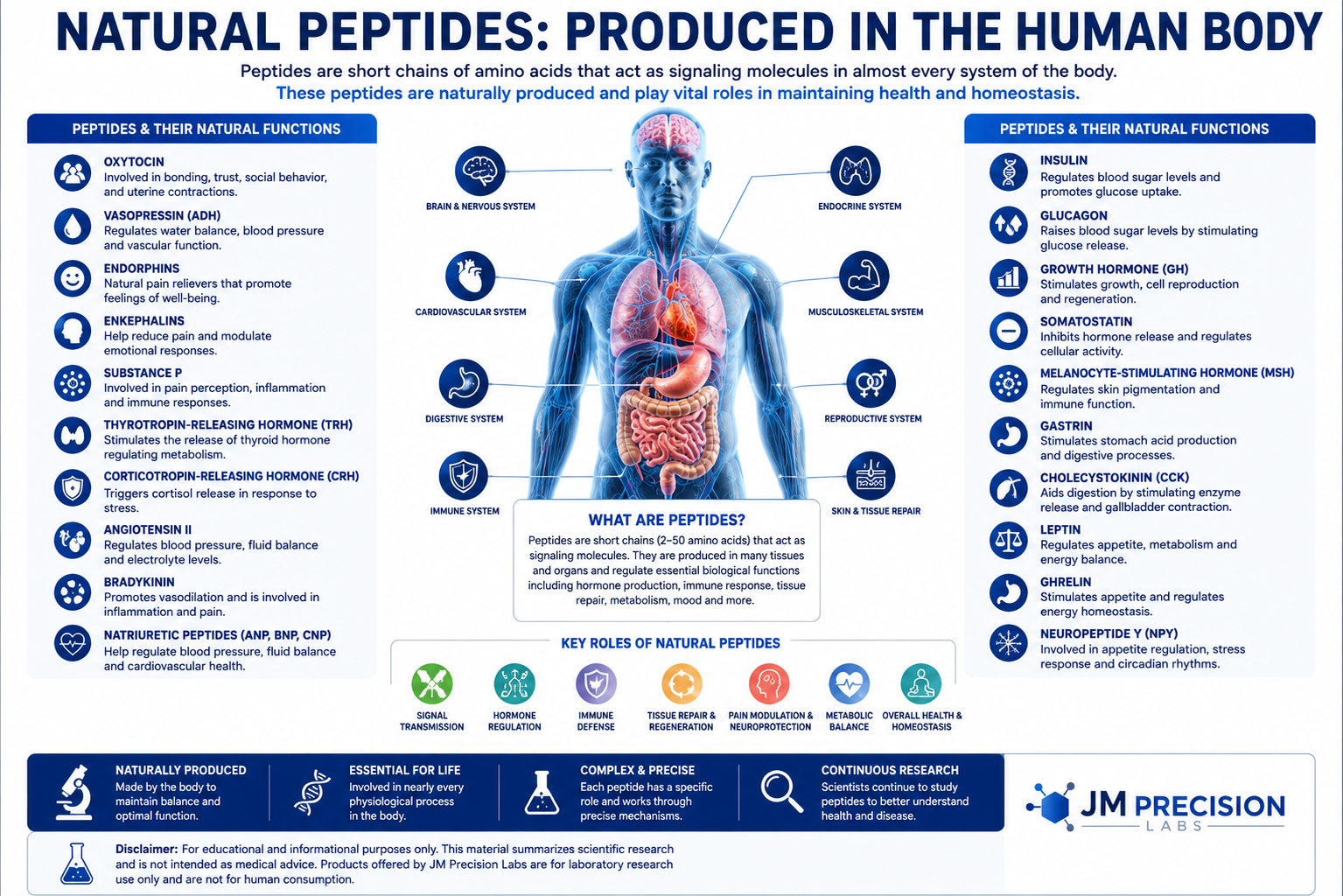
Peptides are short chains of amino acids connected by peptide bonds. They are generally composed of approximately 2 to 50 amino acids, while longer amino-acid chains are usually classified as proteins.
|
Peptides can occur naturally within biological systems or be produced synthetically for laboratory investigation. Naturally occurring peptides participate in many signaling processes, while synthetic peptides may be designed to imitate, modify, or help researchers examine specific biological interactions.
|
In laboratory settings, peptides are studied for their involvement in:
|
- Cellular signaling
- Hormone regulation
- Protein and tissue biology
- Immune-system communication
- Metabolic pathways
|
Why Researchers Are Interested
|
|
One of the primary reasons peptides attract scientific interest is their ability to interact selectively with receptors, enzymes, proteins, and other biological targets. This selectivity allows researchers to explore particular pathways without necessarily affecting every biological system at once.
|
Researchers investigate peptides to better understand:
|
- How cells communicate
- How biological signals are activated or blocked
- How tissues respond to environmental stress
- How hormones regulate cellular activity
- How new research compounds may be developed
|
Key Research Applications for Synthetic Peptides
|
|
Synthetic peptides are used across many areas of scientific research.
|
|
Skin and Structural Biology Research
|
Certain peptides are studied for their interactions with collagen pathways, fibroblast activity, extracellular-matrix organization, and cellular repair mechanisms. These studies are commonly conducted in dermatological, cosmetic-science, and tissue-engineering models.
|
Researchers are investigating how selected peptides interact with follicular cells, growth-factor pathways, and signaling mechanisms associated with the hair-growth cycle. These investigations remain dependent on the exact peptide and research model used.
|
|
Muscle and Metabolic Research
|
Some peptides participate in pathways related to protein signaling, cellular energy, endocrine activity, and tissue adaptation. Synthetic peptides may therefore be used in laboratory studies examining muscle biology, metabolism, and cellular responses to physical stress.
|
Peptides are also studied for their potential interactions with cytokines, immune cells, inflammatory pathways, and host-defense mechanisms. This makes them relevant to immunology, vaccine research, and antimicrobial-development studies.
|
|
Types of Synthetic Peptides
|
Synthetic peptides may be organized into several broad research categories.
|
|
Collagen-Related Peptides
|
These peptides are investigated in research involving collagen signaling, connective-tissue structure, extracellular-matrix maintenance, and dermatological science.
|
Signal peptides are designed or selected to help researchers examine cellular communication. They may imitate naturally occurring signaling molecules or influence receptor and enzyme activity in laboratory models.
|
|
Peptides in Pharmaceutical Development
|
Some synthetic peptides are investigated as potential drug candidates because they can interact with specific biological targets. Their development may involve laboratory studies, preclinical research, and, when authorized, clinical investigation.
|
Antimicrobial peptides are studied for their interactions with bacteria, fungi, viruses, and host-defense pathways. Researchers continue to investigate whether these compounds may contribute to future antimicrobial-development strategies.
|
|
Health and Cosmetic Research Areas
|
Peptide research extends across several scientific fields.
|
|
Dermatological and Cosmetic Science
|
Laboratory studies may examine peptide interactions with skin cells, collagen pathways, inflammatory signaling, pigmentation, and extracellular-matrix organization.
|
Researchers study selected peptides in models involving follicular signaling, scalp biology, and cellular activity associated with the hair-growth cycle.
|
|
Nutritional and Metabolic Science
|
Naturally derived and synthetic peptides may be investigated for their roles in protein metabolism, cellular energy, appetite-related signaling, and other metabolic pathways.
|
Peptides are used in drug-discovery research involving receptors, hormones, enzymes, immune pathways, and other biological targets. Some peptide-based compounds have become approved medicines, while many others remain experimental or limited to laboratory research.
|
Key Properties of Peptides
|
- Composed of short chains of amino acids
- May occur naturally or be produced synthetically
- Participate in cellular signaling and biological regulation
- Can be designed to interact with specific research targets
- Studied across biochemical, cosmetic, metabolic, immune, and pharmaceutical research
Peptides continue to play an important role in modern scientific research because of their structural diversity and ability to interact with specific biological pathways. From cellular communication and tissue biology to immunology and pharmaceutical development, peptides provide researchers with valuable tools for examining complex biological systems. Scientific findings vary significantly among individual peptides. Evidence involving one peptide should not automatically be applied to another, and laboratory or preclinical observations do not establish safety, effectiveness, or approval for human use.
|
|
Disclaimer: This article is intended solely for educational purposes and summarizes general areas of scientific research. The author is not a physician, licensed healthcare provider, or medical professional. Nothing in this article should be interpreted as medical advice or as a recommendation concerning the acquisition, preparation, dosing, administration, or human use of any compound. Research compounds are intended strictly for qualified laboratory research and are not for human consumption, medical use, or therapeutic application.
|
|
|
|
|
|
|