

Research Grade Chemical Compounds: A Comparative Guide to Laboratory Standards (2026)
A Certificate of Analysis is not a guarantee of quality. It’s a data point that is only as reliable as the laboratory that produced it. For professionals managing the procurement of research grade chemical compounds, the distinction between a technical grade and a verified analytical standard is often obscured by inconsistent documentation. You’ve likely faced the frustration of batch variability from offshore suppliers or COAs that lack transparency. It’s a systemic risk to research integrity that demands a more disciplined approach to sourcing.
We’ll provide the framework necessary to evaluate chemical purity with clinical precision. This guide analyzes the technical distinctions between laboratory standards and explains why batch-specific HPLC verification is the only definitive metric for success. By the end of this analysis, you’ll know how to identify suppliers that provide the granular data required for strict in-vitro compliance. We prioritize verification over promises. Let’s look at the data.
Key Takeaways
- Learn to navigate the hierarchy of laboratory grades to ensure your material purity matches your specific analytical requirements.
- Establish a rigorous framework for evaluating research grade chemical compounds by prioritizing batch-specific data over generic manufacturer claims.
- Understand why High-Performance Liquid Chromatography (HPLC) is the only definitive method for confirming compound identity in a laboratory setting.
- Identify the specific markers in a Certificate of Analysis that indicate true batch-specific verification versus recycled documentation.
- Implement a procurement checklist designed to eliminate the risks associated with inconsistent supply chains and offshore quality control.
Understanding Chemical Purity: The Hierarchy of Laboratory Grades
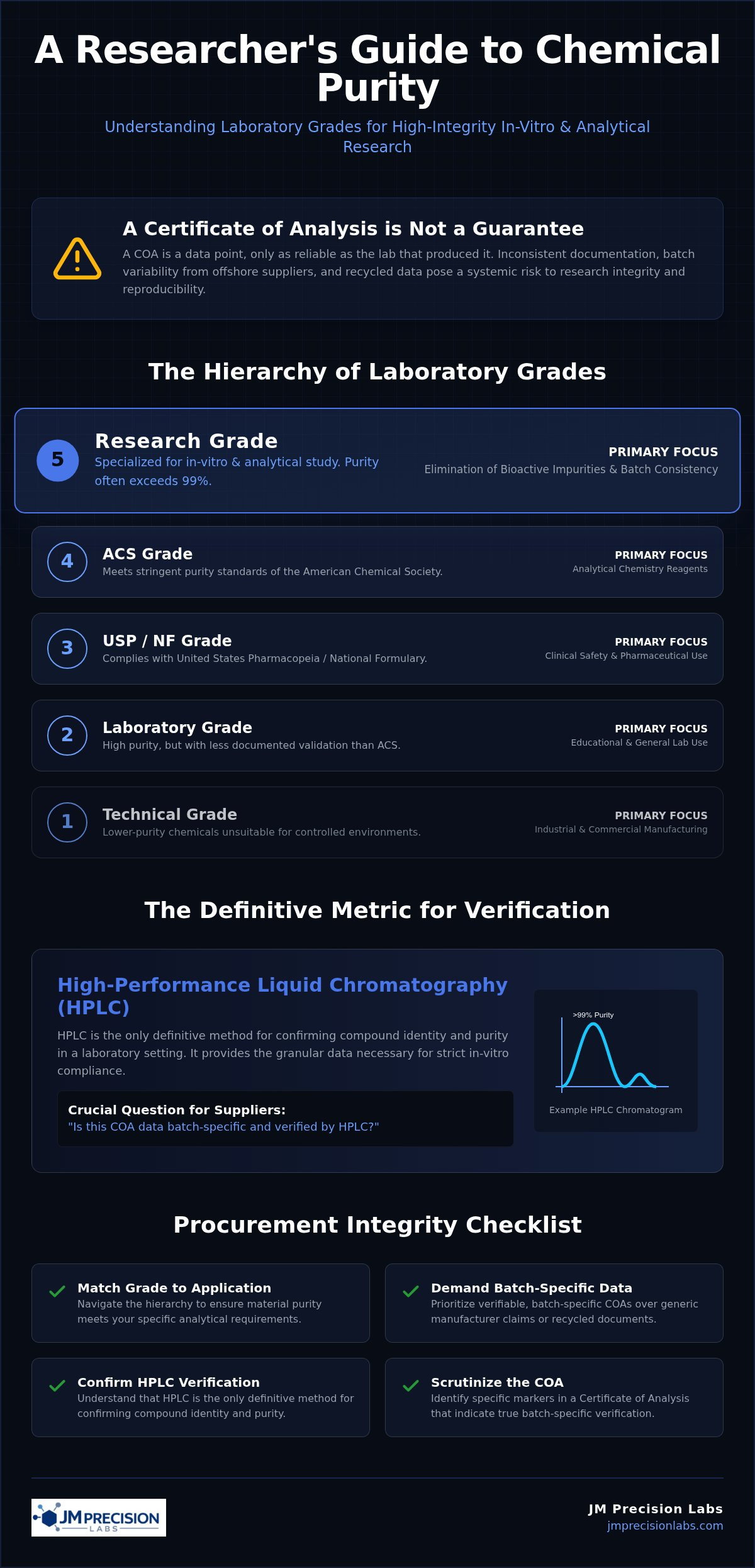
Chemical purity is not a binary state. It’s a spectrum defined by the intended application and the rigor of the testing performed. The Hierarchy of Laboratory Grades provides the necessary framework for researchers to match compound quality with experimental requirements. At the base of this hierarchy sit technical and industrial grades, which are suitable for large-scale manufacturing but unsuitable for controlled environments. As the requirements for precision increase, so does the demand for standardized benchmarks set by regulatory bodies.
Procurement is a technical process. It requires a deep understanding of how these standards differ in their focus. Regulatory bodies establish the floor for quality, yet these benchmarks are often insufficient for specialized study. The hierarchy is typically governed by several key designations:
- ACS Grade: High-purity reagents that meet the stringent standards of the American Chemical Society.
- USP/NF Grade: Materials that meet the requirements of the United States Pharmacopeia or National Formulary, primarily focused on clinical safety.
- Laboratory Grade: Chemicals with a high level of purity but with less documented validation than ACS standards.
- Technical Grade: Lower-purity chemicals intended for industrial use rather than analytical research.
The General Purpose of Chemical Grading
Chemical grades determine the functional boundaries of a compound. Using a technical grade material in a sensitive assay introduces uncontrolled variables. These impurities aren’t always inert; they can act as catalysts or inhibitors in biological systems. This leads to the primary failure in modern science: lack of reproducibility. Data integrity depends on the consistency of the starting material. While the global market is saturated with various grading systems, many remain non-standardized. This makes it difficult to compare products between suppliers without independent verification. A standardized grade is a promise of consistency. A non-standardized grade is a liability.
Research Grade: Purity Beyond Industrial Standards
The term research grade chemical compounds describes a specialized class of materials designed for in-vitro and analytical study. These compounds often exceed the purity requirements of standard laboratory-grade chemicals. The focus shifts from general purity to the specific elimination of bioactive impurities. These contaminants can interfere with cellular signaling or metabolic pathways, leading to false positives or invalid conclusions. Consistency is the metric that matters most.
High-integrity research requires compounds with stable molecular weight and predictable solubility. When a supplier labels a compound as research grade, they’re claiming a level of refinement that supports advanced analytical work. However, the label itself is not the proof. Verification is the proof. In a landscape where offshore suppliers often provide inconsistent batches, the burden of proof lies with the documentation. Research grade is a standard of necessity. It ensures that the results observed in the lab are a product of the compound itself, not its impurities. Precision is the goal. Data drives the decision.
Research Grade vs. USP and ACS Standards: A Technical Comparison
Understanding the technical nuances between standardized certifications and specialized designations is mandatory for laboratory procurement. While ACS and USP grades provide a baseline for quality, they serve different functional purposes. Research grade chemical compounds are often selected when analytical precision is the primary requirement, rather than clinical safety or general reagent utility. The choice between these grades dictates the reliability of the resulting data.
ACS and Reagent Grade: The Benchmarks of Purity
ACS certification is a rigorous standard for high-purity reagents. It defines maximum allowable limits for specific impurities such as heavy metals, chlorides, and sulfates. The ACS Reagent Grade is the definitive benchmark for chemicals used in analytical chemistry where consistency is non-negotiable. Reagent grade is typically sufficient for standard titration or synthesis. However, specialized research often demands 99% purity or higher to eliminate trace contaminants that ACS monographs might not specifically target. If a study requires the isolation of specific molecular interactions, the broader purity thresholds of standard reagents may introduce unacceptable variables. Precision requires a narrower focus than general laboratory standards provide.
USP and NF: The Clinical Distinction
The United States Pharmacopeia (USP) and National Formulary (NF) standards are designed for the pharmaceutical industry. Their primary focus is clinical safety, toxicity profiles, and human-grade efficacy. While USP grade chemicals are high quality, they’re often formulated with excipients, stabilizers, or preservatives necessary for shelf life and biological delivery. These additives are “noise” in an in-vitro environment. Sourcing research grade chemical compounds ensures the absence of these bioactive additives to ensure that the compound’s behavior is the only variable being measured. For researchers, a USP designation doesn’t always translate to analytical suitability. If a compound contains a stabilizer to prevent degradation in a clinical setting, that same stabilizer might inhibit enzymatic activity in your assay.
Evaluating the cost-to-purity ratio is a logistical necessity. High-purity research compounds carry a higher procurement cost due to the intensive purification and verification processes required. The cost of a failed study due to batch contamination is significantly higher. For large-scale analytical studies, the investment in verified research grade materials is a risk-mitigation strategy. It’s more efficient to source verified research compounds than to attempt to correct data skewed by unknown impurities. Precision is a procedural requirement, not an optional upgrade. Procurement should focus on the specific analytical necessity of the project. Data integrity depends on this distinction.
The Criticality of Analytical Verification: HPLC and Batch-Specific COAs
A purity claim is a hypothesis until it is verified through rigorous analytical testing. In the procurement of research grade chemical compounds, the absence of verification is a procedural failure. The supply chain for these materials is complex and often lacks transparency, especially when dealing with offshore manufacturers. Batch-specific verification serves as the final barrier between a compromised experiment and reliable data. It’s the only way to ensure that the material in the vial matches the label on the box. Precision is a requirement, not a preference.
HPLC Testing: The Gold Standard of Verification
High-Performance Liquid Chromatography (HPLC) is the primary mechanism for verifying research compound purity. This method separates the components of a mixture, allowing for the identification of trace impurities that might otherwise remain undetected. Qualitative results confirm the identity of the molecule, while quantitative results provide the exact concentration of the compound. HPLC doesn’t just estimate purity; it maps the chemical profile of the batch with absolute precision. This level of detail is necessary to identify degradants or synthesis byproducts that could skew in-vitro results. Verification is a technical requirement, not a secondary consideration. Data must be reproducible.
The Necessity of Batch-Specific Documentation
Generic Certificates of Analysis (COAs) are a systemic risk. Many suppliers provide “typical” analysis reports that reflect a historical standard rather than the specific material being shipped. This practice obscures batch-to-batch variability. For high-stakes analytical research, you must demand a COA that corresponds exactly to the lot number of your specific sample. An effective COA goes beyond the purity percentage; it includes the raw chromatogram and the specific parameters of the test performed. This granularity allows researchers to account for any trace elements present in the compound.
Third-party verification adds a layer of accountability that internal testing cannot match. It removes the conflict of interest inherent in self-regulation. When evaluating suppliers, prioritize those who provide transparent access to Understanding Third Party Tested Research Compounds. This documentation is the definitive record of integrity. It connects the physical compound to its analytical reality. Without batch-specific HPLC data, the risk of supply chain degradation is too high to ignore. Interpreting a COA requires a disciplined eye. Look for the baseline stability and peak integration in the chromatogram. If the report lacks these technical details, the verification is incomplete. Third-party verification establishes research integrity by providing an objective, external audit of the quality. It ensures that internal standards align with global analytical benchmarks. Procurement must be a data-driven process. Trust the verification, not the label.
Sourcing Compounds for In-Vitro and Analytical Research
Procurement of research grade chemical compounds requires a transition from passive purchasing to active verification. The choice of supplier is a variable that affects the final data set. International sourcing often introduces variables like temperature fluctuations during long-duration shipping or customs delays that can compromise molecular stability. Domestic sourcing provides a more controlled logistical environment. It ensures faster transit and clearer lines of accountability. US-based shipping is a strategic choice for time-sensitive research. It minimizes the window of exposure to environmental stressors.
Sourcing Checklist for Research Professionals
A rigorous procurement process begins with a standardized checklist. This ensures that every compound meets the necessary analytical benchmarks before it enters the laboratory. Efficiency is a logistical requirement. Reliability is a procedural one. Use the following criteria to evaluate potential suppliers:
- Third-Party Verification: Confirm that the supplier uses independent laboratories for HPLC testing. Verify that these credentials are current and accessible.
- Logistical Transparency: Real-time shipping tracking is essential. Researchers must know exactly when a compound arrives to manage storage protocols.
- Scalability: High-volume studies require consistent material. Evaluate the availability of bulk discount packages to ensure long-term project viability.
- Documentation Accessibility: Batch-specific COAs must be available for review prior to purchase. Generic reports are insufficient.
Compliance and Ethical Standards
The “In-Vitro and Analytical Use Only” restriction is not a suggestion. It is a fundamental boundary. These compounds are purified for analytical precision, not clinical safety. Adhering to the “Not for Human Consumption” standard is a legal and ethical requirement. Researchers are responsible for maintaining non-clinical compliance within their facilities. This includes following established Protocols for In Vitro Research Compounds to prevent cross-contamination or accidental misuse. Compliance is a shared responsibility between the supplier and the end-user.
Ethical sourcing also involves transparency regarding the compound’s origins and testing history. A supplier that obscures its analytical data is a risk to the scientific community. Integrity is the definitive standard. If a supplier cannot provide a clear chain of custody or batch-specific verification, they don’t meet the requirements for professional research. You can order verified research compounds that meet these rigorous transparency standards today. Data drives the decision. Verification ensures the result.
Procurement Integrity: The JM Precision Labs Approach to Research Compounds
Reliability is not an abstract concept. It’s a procedural outcome. At JM Precision Labs, we recognize that the integrity of your data depends entirely on the chemical purity of your starting material. Providing research grade chemical compounds requires more than a label; it requires a disciplined chain of custody and rigorous analytical verification. We operate as a professional institution dedicated to procedural accuracy. Integrity is our primary metric. We don’t just supply compounds. We provide the analytical foundation for your research.
The JM Precision Labs Verification Protocol
Every compound in our inventory undergoes a multi-stage verification process. We don’t rely on manufacturer assertions. Instead, we implement batch-specific HPLC testing to confirm molecular identity and purity for every lot. Third-party verification is the cornerstone of our quality control. It provides an objective audit that eliminates internal bias and ensures that every Certificate of Analysis (COA) is an accurate reflection of the material in the vial. This protocol ensures that the trace impurity profile of every lot is documented and transparent. We provide the raw data. You make the analytical decision. Transparency isn’t just a value; it’s a mechanism for scientific progress. Our commitment to high-integrity sourcing means you never have to interpret vague documentation or guess at batch quality. Precision is a requirement. We meet it every time.
Efficient Procurement for Modern Research
Research timelines are rigid. Delays in procurement translate to lost data and wasted resources. Our logistical framework is designed for efficiency. We utilize streamlined US-based shipping protocols to ensure that compounds arrive without the risks associated with international transit. Every shipment includes real-time tracking. You’ll know exactly when your material reaches the lab. For large-scale analytical projects, we offer bulk discount packages that maintain supply chain consistency without compromising analytical standards. This ensures that long-term studies use the same verified lot, which reduces inter-batch variability and strengthens the validity of your results. We prioritize your timeline as much as your data purity. Data demands precision. We deliver it through a meticulous, no-nonsense approach to laboratory standards. You can Secure Research Grade Chemical Compounds for Your Analysis through our verified procurement portal today. Compliance is maintained. Results are verified. Research is protected.
Advancing Analytical Accuracy Through Verified Procurement
The integrity of your research depends on the technical precision of your starting materials. Standard chemical grades often fail to provide the granular detail required for sensitive analytical work. True research grade chemical compounds are defined by their verification process, not their marketing labels. Batch-specific HPLC testing remains the definitive standard for identifying trace impurities that compromise in-vitro results. Relying on generic documentation is a systemic risk that introduces uncontrolled variables into your study. It’s a risk that professional laboratories cannot afford to take.
We prioritize procedural rigor. By utilizing third-party tested purity and real-time tracking for domestic shipping, we ensure that every compound arrives with its analytical profile fully documented. Supply chain stability is a requirement for reproducible data. You can Procure Verified Research Grade Chemical Compounds with the assurance of batch-specific HPLC verification today. Secure your research outcomes through disciplined sourcing and transparent data. We look forward to supporting your next analytical breakthrough.
Frequently Asked Questions
What is the primary difference between research grade and laboratory grade?
Research grade implies higher purity and more rigorous documentation than standard laboratory grade. While laboratory grade is suitable for general use, research grade chemical compounds are purified to eliminate specific bioactive contaminants that interfere with analytical assays. This distinction is defined by the depth of verification and the consistency of the molecular profile across batches. Laboratory grade often lacks the batch-specific HPLC data required for high-stakes study.
Is research grade the same as HPLC grade?
No, they are not identical. HPLC grade refers specifically to solvents or compounds purified to a level that prevents interference with chromatography equipment, such as baseline noise or column contamination. Research grade is a broader designation focusing on the compound’s suitability for in-vitro study. A compound can be research grade without meeting the specific requirements for mobile phase chromatography. Both require high purity, but their functional applications differ.
Can research grade chemical compounds be used for human trials?
Absolutely not. These materials are strictly for in-vitro and analytical research use only. They are not manufactured under the Good Manufacturing Practices (GMP) required for clinical safety or human consumption. Using research-grade materials in a clinical or human context is a violation of safety standards and legal requirements. Integrity in research requires strict adherence to these boundaries. These compounds are intended for laboratory evaluation only.
How do I verify the authenticity of a batch-specific COA?
Verification requires matching the lot number on the physical product to the unique identification number on the Certificate of Analysis. A legitimate COA must include a detailed chromatogram, peak integration data, and the specific date of the test. You should contact the issuing laboratory directly to confirm the report’s validity if the documentation appears generic or lacks granular analytical data. Transparency is the definitive standard for verification.
Why is third-party testing preferred over in-house testing for research compounds?
Third-party testing provides an objective, external audit that removes the conflict of interest inherent in self-regulation. It ensures that the analytical results are unbiased and verified by a laboratory with independent standards. This external verification is the definitive standard for research integrity. It provides researchers with a higher level of confidence in the compound’s purity and molecular identity. Data must be verified by a neutral entity to be reliable.
What impurities are typically identified during HPLC testing of research compounds?
HPLC testing identifies trace degradants, synthesis byproducts, and residual solvents. It maps the presence of any molecules that differ from the target compound’s retention time. This process allows for the detection of bioactive impurities that could skew experimental data. By quantifying these elements, researchers can ensure the observed biological responses are caused solely by the primary compound. Verification eliminates the noise from trace contaminants in your data set.
How does domestic shipping impact the integrity of research compounds?
Domestic shipping reduces the duration of environmental exposure and eliminates the risks of customs-related delays. Shorter transit times minimize the potential for thermal degradation, which is critical for maintaining molecular stability. We utilize real-time tracking for all domestic shipments to ensure that researchers can manage storage protocols immediately upon arrival. This logistical control is essential for supply chain integrity. Faster transit ensures the compound remains within its specified parameters.
Are bulk discounts available for research grade chemical compounds?
Yes, bulk discount packages are available for large-scale analytical projects. These structures support research continuity by allowing teams to procure a single, verified lot for long-term study. This reduces inter-batch variability and ensures consistent data across multiple phases of a project. Procurement efficiency is prioritized through these tiered pricing models to support extensive analytical requirements. Consistent supply chains are necessary for long-duration research. Batch consistency is maintained through bulk procurement.
Disclaimer
JM Precision Labs – Research Use Disclaimer
All products offered by JM Precision Labs are intended solely for laboratory research and scientific investigation. They are not intended for human or animal consumption, therapeutic use, diagnostic use, or clinical application.
Products sold by JM Precision Labs are for use only by qualified researchers and laboratory professionals who understand the potential hazards associated with handling research compounds. By purchasing from JM Precision Labs, the customer acknowledges that they are acquiring these products for legitimate research purposes only and agrees to comply with all applicable federal, state, and local laws and regulations.
JM Precision Labs makes no representations or warranties regarding the fitness of any product for any particular purpose beyond laboratory research. Customers assume full responsibility for the safe handling, storage, use, and disposal of all products purchased.
The information provided on this website, product labels, marketing materials, emails, or social media is for educational and informational purposes only and should not be interpreted as medical advice, treatment recommendations, or claims regarding the safety, efficacy, or intended use of any product.
JM Precision Labs shall not be liable for any damages, losses, or claims arising from the misuse, improper handling, or unauthorized use of its products.
By accessing this website and/or purchasing from JM Precision Labs, you acknowledge that you have read, understood, and agree to this disclaimer.






One Comment