

Research Chemical Shipping Tracking: A Technical Guide to Logistical Verification
Logistical tracking isn’t a luxury. It’s a fundamental requirement for laboratory verification. For the professional researcher, uncertainty regarding delivery timelines is more than an inconvenience; it’s a threat to analytical integrity. Precise research chemical shipping tracking serves as the primary mechanism for maintaining a rigorous chain of custody. Without it, the risk of misrouted materials or compromised study schedules increases significantly. Supply chain transparency is non-negotiable.
You understand that predictable arrival is essential for high-stakes, time-sensitive studies. This guide provides the technical protocols necessary to monitor research compound logistics with clinical accuracy. By mastering these monitoring systems, you ensure absolute accountability for every gram in transit. We’ll examine domestic U.S. carrier verification, the impact of the 2026 PHMSA electronic registration updates, and the specific procedures required to transform logistical data into verified laboratory efficiency. Reliability is achieved through procedural rigor, not chance. Every shipment requires confirmation.
Key Takeaways
- Define research chemical shipping tracking as a formal logistical verification protocol rather than a standard commercial convenience.
- Monitor real-time telemetry to maintain precise oversight of analytical compound transit.
- Deploy specific troubleshooting procedures to address logistical delays or missed scans without compromising study timelines.
- Align logistical transparency with batch-specific certificates of analysis to establish a comprehensive chain of custody.
- Prioritize domestic shipping protocols to ensure predictable arrival and maintain maximum laboratory efficiency.
The Infrastructure of Research Chemical Shipping Tracking
Research chemical shipping tracking functions as a technical verification protocol, not a secondary customer service feature. In a laboratory environment, every variable must be controlled. Logistics is no exception. This infrastructure relies on seamless API integration between a supplier’s internal system and national carriers. When these systems sync, they generate real-time telemetry that allows researchers to anticipate arrival with mathematical precision. This transparency supports a documented chain of custody, ensuring that the integrity of the compound is monitored from the moment of dispatch until it reaches the analytical bench. It’s about data-driven accountability.
Automated dispatch notifications are critical for modern laboratory workflows. These alerts trigger internal inventory updates, allowing procurement officers to schedule sensitive studies around confirmed arrival dates. It’s a matter of efficiency. Tracking data isn’t just a location; it’s a tool for resource allocation. By integrating this data into scale studies, researchers can maintain leaner inventories without risking project downtime. Predictability is the baseline for scientific progress.
Digital Integration in Chemical Logistics
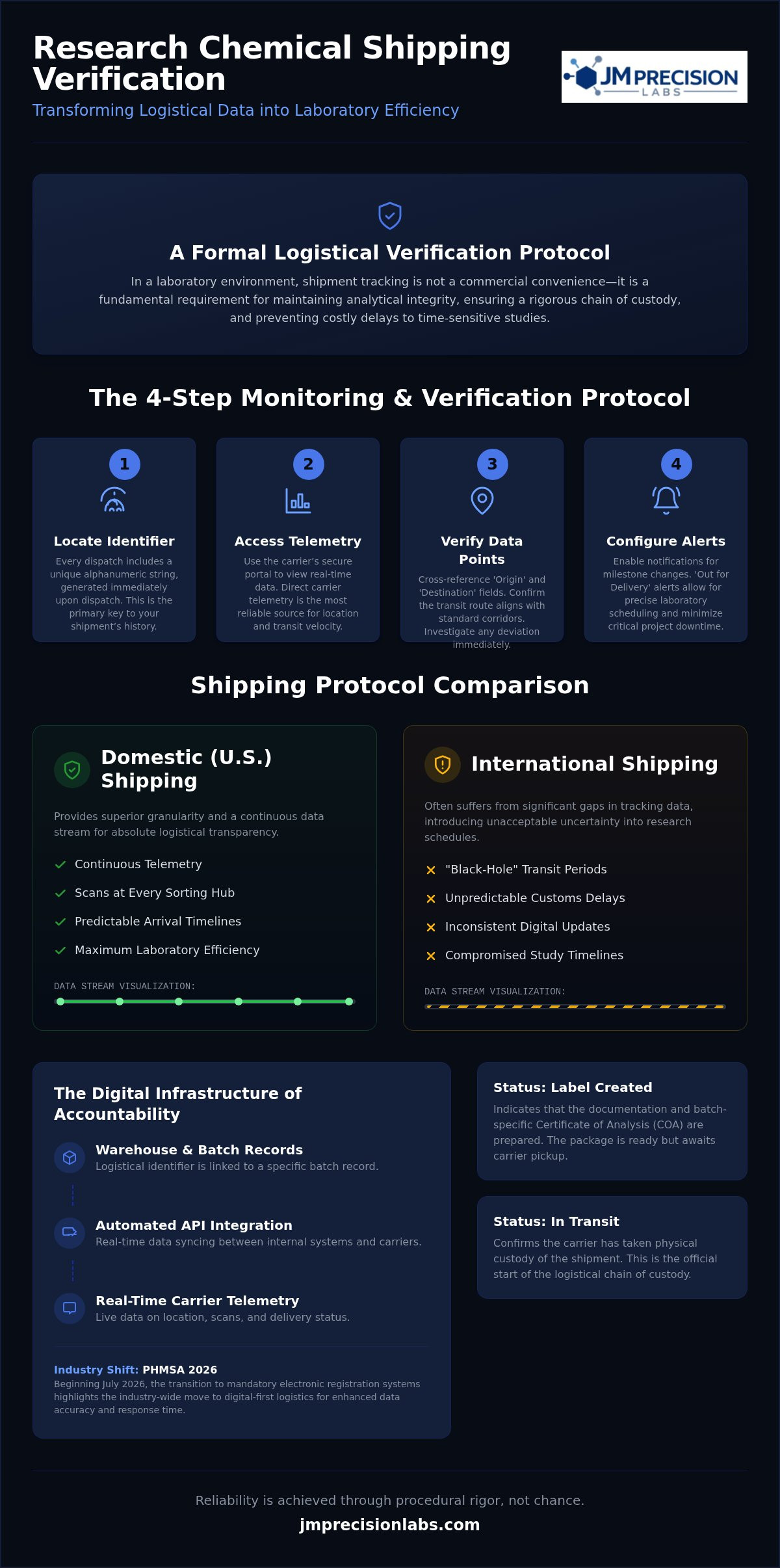
Modern logistics requires real-time data syncing between warehouse management systems and carrier databases. Manual entry introduces unacceptable margins for error. Automated tracking generation ensures that the logistical identifier is permanently linked to the specific batch record. In high-volume research compound distribution, this level of digital integration is the only way to maintain data accuracy. Beginning in July 2026, the transition to electronic registration systems by the PHMSA highlights a broader industry shift toward digital-first logistics. This reduces administrative lag and ensures that emergency response information is accessible instantly if required during transit.
Domestic vs. International Tracking Limitations
Domestic shipping provides superior granularity in research chemical shipping tracking data. Within the U.S. infrastructure, packages are scanned at every major sorting hub and local distribution center. This creates a continuous data stream. International chemical transit, however, often suffers from “black-hole” periods. These occur when a package changes hands between different postal authorities or sits in customs without digital updates. U.S.-based sourcing eliminates these gaps. By focusing on domestic logistics, researchers gain absolute transparency and avoid the unpredictable delays associated with global transit routes. Reliable data requires a closed, domestic loop.
How to Monitor and Interpret Your Shipment Data
Effective procurement requires active oversight. Monitoring research chemical shipping tracking is a four-step protocol designed to eliminate logistical ambiguity. This process ensures that your laboratory remains prepared for the arrival of sensitive analytical materials. Accuracy is the priority. Follow these steps to verify your shipment’s progress through the domestic U.S. infrastructure.
- Step 1: Locate the identifier. Every dispatch includes a unique logistical identifier. This alphanumeric string is the primary key for your shipment’s history. It is generated immediately upon laboratory dispatch.
- Step 2: Access the telemetry. Use the carrier’s secure portal to view real-time telemetry. Direct carrier data is the most reliable source of truth for current location and transit velocity.
- Step 3: Verify data points. Cross-reference the ‘Origin’ and ‘Destination’ fields. Confirm that the transit route aligns with standard domestic corridors. Any deviation requires immediate investigation.
- Step 4: Configure automated alerts. Enable notifications for milestone changes. Receiving a notification when a package is ‘Out for Delivery’ allows for precise laboratory scheduling. It minimizes downtime.
When you order research compounds, these tracking protocols become an extension of your own internal quality control. Accountability begins at the point of origin.
Accessing Your Tracking Information
Tracking data is accessible through the JM Precision Labs secure portal. It’s important to distinguish between ‘Label Created’ and ‘In Transit’ statuses. ‘Label Created’ indicates that the documentation and batch-specific COA are prepared; ‘In Transit’ confirms that the carrier has taken physical custody. If a confirmation email is not received within one hour of the expected dispatch time, verify your server’s whitelist settings. Security filters often misclassify automated logistical alerts as junk mail. Prompt retrieval of the identifier is essential for maintaining the chain of custody.
Interpreting Carrier Status Codes
Carrier status codes provide granular insight into the shipment’s condition. A ‘Pre-Shipment’ status indicates the batch is awaiting its initial carrier scan at the domestic hub. This is a standard phase of the fulfillment cycle. However, an ‘Exception’ or ‘Delivery Delay’ code indicates a logistical anomaly. These may stem from localized weather events or carrier-side equipment failures. Identifying these exceptions early allows you to adjust your analytical study timelines accordingly. Transparency in data allows for proactive laboratory management. Every scan is a verification point.
Troubleshooting Research Compound Logistics Issues
Logistical anomalies require a systematic diagnostic approach. While the infrastructure is robust, researchers must remain prepared for technical interruptions. Stagnant research chemical shipping tracking updates don’t always indicate a lost shipment; they often signal a carrier-side scan omission. When an identifier fails to update for more than 24 hours during a domestic transit window, it’s time to initiate a formal verification protocol. This proactive stance ensures that analytical study timelines remain protected. Every hour of data silence requires an assessment of the transit route.
Addressing a ‘Delivered’ status without physical receipt is a critical priority. This discrepancy suggests a breach in the local delivery sequence. Verify the exact GPS coordinates of the delivery scan with the carrier immediately. If the data confirms a misdelivery, coordinate with JM Precision Labs support to resolve the logistical failure. Accountability is maintained through rigorous documentation at every stage of the process. We prioritize the integrity of your procurement records.
Managing Transit Delays
Differentiating between carrier delays and supplier processing is the first step in troubleshooting. Supplier processing concludes once the logistical identifier is generated and the carrier accepts the package. Carrier delays often stem from hub congestion or localized equipment failures. Domestic shipping for research compounds significantly mitigates long-term delays. Unlike international routes that can be stalled for weeks by customs audits, domestic packages typically resolve within 48 hours of a reported delay. If a delay exceeds the standard transit window for 2026, which remains 2 to 5 business days for most U.S. corridors, initiate a carrier inquiry. Digital-first compliance, accelerated by the August 2026 PHMSA updates, now allows for faster electronic resolution of these inquiries by phasing out paper-based response systems.
Protocol for Missing Shipments
Initial verification must occur at the laboratory receiving dock. Check for signature confirmation data to identify the specific individual who accepted the package. If no record exists, document the failure for your procurement files. This documentation is essential for internal audits and laboratory insurance claims. Real-time tracking data serves as primary evidence in these investigations. It provides a timestamped record of where the chain of custody was interrupted. Maintaining a disciplined record of these events ensures that your laboratory can recover quickly. It also maintains your analytical standards without unnecessary financial loss. Precision in documentation is as vital as precision in the lab.
Verification Standards: Tracking and Chain of Custody
Logistical transparency is a prerequisite for analytical integrity. It bridges the gap between laboratory production and bench application. Research chemical shipping tracking serves as the primary layer of batch-specific verification. It provides a verifiable record of a compound’s movement through the domestic supply chain. This data is not optional for high-integrity research; it’s a fundamental requirement. By integrating logistical data into the broader quality control framework, laboratories ensure that every compound remains accounted for. Verification is the standard. Precision is the outcome.
The Chain of Custody Requirement
A chain of custody defines the documented sequence of possession for sensitive materials. In analytical research, this documentation must be unassailable. Real-time tracking provides a digital audit trail that records every handover within the domestic network. This level of oversight is critical for maintaining professional standards.
- Origin Confirmation: Verifies the material originated from a controlled laboratory environment.
- Carrier Accountability: Identifies the specific entities responsible for the material during transit.
- Timestamped Receipt: Provides a definitive record of when the chain of custody transitioned to the receiving laboratory.
This data allows procurement officers to conduct rigorous internal laboratory compliance auditing. It proves that the material was never outside of a controlled logistical environment. Integrity is maintained from the supplier to the bench. Accountability is absolute.
Logistics and Compound Stability
Compound stability is directly influenced by transit duration. Sensitive research materials often have specific environmental tolerances. Fast shipping is a stability-preservation strategy. By minimizing the time a compound spends in the logistical system, laboratories reduce the risk of exposure to thermal or mechanical stress. Transit velocity is a quality variable. Tracking milestones are essential for laboratory preparation. When a researcher knows exactly when a shipment will arrive, they can prepare the analytical environment in advance. This ensures that the material is transitioned into proper storage immediately upon receipt. Efficiency protects the analytical profile. Predictability ensures results.
Access our research compounds to ensure your next study is supported by these rigorous logistical standards.
The JM Precision Labs Logistics Protocol
The JM Precision Labs logistics protocol is an extension of our internal laboratory standards. We don’t view shipping as a post-production afterthought; it’s a critical phase of the compound’s lifecycle. Our protocol integrates batch-specific certificates of analysis (COAs) with logistical data to ensure a seamless transition from our facility to yours. Every order is subjected to internal verification steps before a logistical identifier is generated. This ensures that the documentation and the physical compound are perfectly aligned. Accuracy is the baseline.
Real-time research chemical shipping tracking is provided immediately upon dispatch for every order. We maintain a commitment to transparency that allows researchers to verify the chain of custody in real-time. For large-scale analytical studies, we offer bulk discount packages and free shipping on orders exceeding $200. This threshold is designed to support the logistical requirements of high-volume procurement without compromising on speed or data granularity. Predictability is the standard.
Streamlined Domestic Logistics
We focus exclusively on U.S. geography. This geographical restriction is a deliberate choice to maximize reliability and maintain strict regulatory compliance. International transit introduces unacceptable variables and data gaps. By utilizing professional carriers within the domestic network, we ensure that sensitive research materials are handled with the necessary care. Our internal verification process includes a final audit of the batch-specific COA against the shipping manifest. Only after this confirmation is the package released to the carrier. This disciplined approach minimizes errors and ensures that the tracking data you receive is accurate from the first scan. Domestic focus ensures speed.
Securing Your Research Supply Chain
Integrating JM Precision Labs into your procurement workflow is straightforward. Our system is designed for professional researchers who value efficiency. For laboratories conducting extensive studies, our bulk discount packages provide a cost-effective mechanism for securing high-purity compounds. Utilizing our research chemical shipping tracking data allows your procurement team to maintain precise inventory levels. It eliminates guesswork. Accountability is maintained through every mile of transit.
To initiate a verified order, select your required research compounds and proceed through our secure portal. The system automatically applies bulk pricing where applicable. Once the order is confirmed, you’ll receive immediate access to the logistical telemetry and the associated certificate of analysis. This dual-layer verification—analytical and logistical—is the foundation of a secure research supply chain. Reliability is built into the protocol. Precision is guaranteed.
Standardizing Your Analytical Supply Chain
Logistical data serves as the primary mechanism for verifying a research compound’s integrity. Precise oversight allows for efficient laboratory scheduling and ensures that the chain of custody remains unbroken. Digital-first protocols, accelerated by the 2026 PHMSA updates, have transformed shipping into a verifiable data stream. This transparency is essential for maintaining professional standards in any analytical environment. Reliability is the result of rigorous procedural adherence. Every data point in the transit record supports your final results.
Implementing a disciplined protocol for research chemical shipping tracking protects your analytical studies from unpredictable domestic delays. JM Precision Labs maintains these standards through fast, domestic-only shipping and the inclusion of batch-specific certificates of analysis with every order. This integrity-first approach ensures your laboratory operates with absolute accountability. We prioritize the technical transparency your research requires. Maintain your laboratory standards through disciplined logistical verification. Precision is achievable through standardized oversight.
Secure Your Research Compounds with Real-Time Tracking
Frequently Asked Questions
How soon after ordering will I receive my tracking number?
You’ll receive your tracking identifier immediately upon dispatch from our facility. This typically occurs within 24 hours of order confirmation after our internal laboratory verification steps are complete. The system sends an automated notification to your registered email address. Prompt delivery of this data ensures that your procurement team can begin monitoring the chain of custody without delay. Accountability starts at the moment the carrier accepts the package for domestic transit.
What should I do if my research chemical shipping tracking hasn’t updated in 48 hours?
If your research chemical shipping tracking remains stagnant for 48 hours, initiate a carrier inquiry. Stagnant data often results from a missed scan at a domestic hub rather than a lost shipment. Verify if there are localized weather events or hub congestion affecting the route. If the status doesn’t update within 72 hours, contact our support team to cross-reference the logistical telemetry with our internal dispatch records for resolution.
Does JM Precision Labs offer expedited shipping for time-sensitive research?
We prioritize fast domestic shipping to meet the requirements of time-sensitive analytical research. While we don’t offer international transit, our domestic-only focus ensures that shipments move through the most efficient U.S. corridors. Typical transit times in 2026 range from 2 to 5 business days depending on the destination. You can monitor these timelines in real-time through the secure portal to ensure your laboratory is prepared for the arrival of sensitive materials.
Can I track multiple orders simultaneously through the lab portal?
Yes, the JM Precision Labs secure portal allows for the simultaneous monitoring of multiple orders. This feature is designed for laboratories managing large-scale analytical studies or frequent procurement cycles. Each order is listed with its unique logistical identifier and current telemetry status. Centralizing this data allows procurement officers to maintain a comprehensive digital audit trail across their entire supply chain. It simplifies the verification of multiple chain of custody records.
What carriers are used for domestic research compound delivery?
We utilize professional national carriers for all domestic research compound delivery. These carriers are selected for their ability to provide granular tracking data and maintain reliable transit schedules within the U.S. network. By sticking to established national infrastructure, we ensure that every shipment is handled according to standardized logistical protocols. This approach minimizes the risk of the data gaps often found in international or smaller regional courier services.
What happens if the tracking says delivered but the lab hasn’t received the package?
If a shipment is marked as delivered but hasn’t reached your bench, verify the delivery scan’s GPS coordinates with the carrier. Check your laboratory’s receiving dock logs and confirm if a signature was recorded. Occasionally, carriers scan packages as delivered while they are still on the vehicle for the final route segment. If the material is not located within four hours of the delivery scan, contact our support team to initiate a formal investigation.
Is a signature required for the delivery of research compounds?
Signature requirements depend on the specific carrier protocol and the nature of the research compounds being shipped. In many cases, a signature is required to maintain a verified chain of custody and ensure the material is received by authorized laboratory personnel. This requirement prevents sensitive analytical materials from being left unattended. Review your specific tracking telemetry to see if signature confirmation is active for your current domestic shipment.
Does the tracking information include batch-specific data?
While the carrier’s tracking portal focuses on logistical telemetry, the JM Precision Labs portal links your research chemical shipping tracking identifier directly to batch-specific data. This integration allows you to access the certificate of analysis for the specific batch in transit. Linking logistical transparency with analytical verification ensures that you have all necessary documentation for laboratory compliance before the material arrives. It creates a complete record from production to delivery.
Disclaimer
JM Precision Labs – Research Use Disclaimer
All products offered by JM Precision Labs are intended solely for laboratory research and scientific investigation. They are not intended for human or animal consumption, therapeutic use, diagnostic use, or clinical application.
Products sold by JM Precision Labs are for use only by qualified researchers and laboratory professionals who understand the potential hazards associated with handling research compounds. By purchasing from JM Precision Labs, the customer acknowledges that they are acquiring these products for legitimate research purposes only and agrees to comply with all applicable federal, state, and local laws and regulations.
JM Precision Labs makes no representations or warranties regarding the fitness of any product for any particular purpose beyond laboratory research. Customers assume full responsibility for the safe handling, storage, use, and disposal of all products purchased.
The information provided on this website, product labels, marketing materials, emails, or social media is for educational and informational purposes only and should not be interpreted as medical advice, treatment recommendations, or claims regarding the safety, efficacy, or intended use of any product.
JM Precision Labs shall not be liable for any damages, losses, or claims arising from the misuse, improper handling, or unauthorized use of its products.
By accessing this website and/or purchasing from JM Precision Labs, you acknowledge that you have read, understood, and agree to this disclaimer.